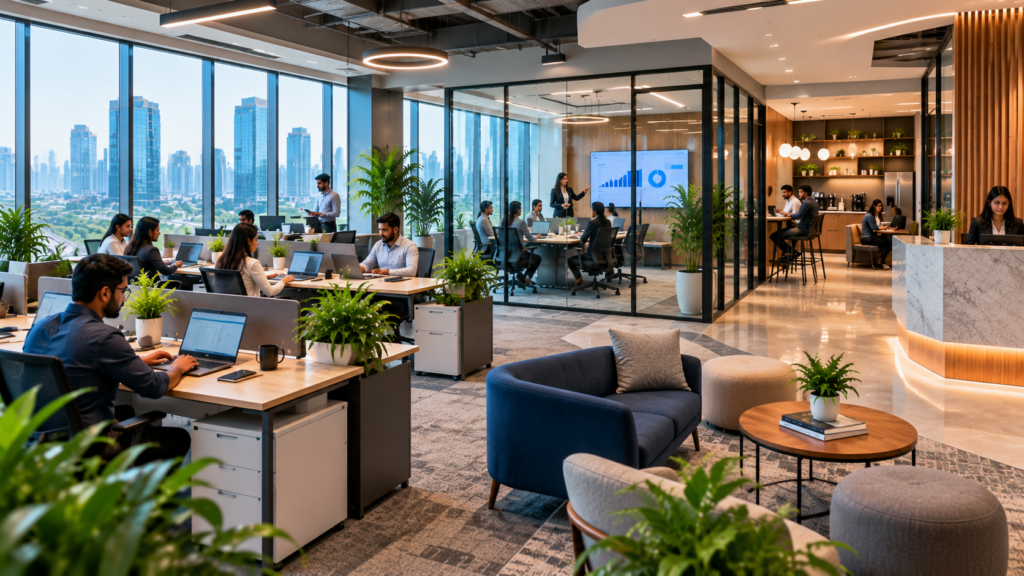
Office Infrastructure Every Startup Needs: A Complete Guide for 2026
Starting a business requires more than a good idea, talented employees and a strong business plan. The right office infrastructure can directly influence productivity, collaboration, employee experience and the professional image of a startup.
For a growing startup, investing in unnecessary office infrastructure can increase costs, while having inadequate facilities can affect day-to-day operations. The ideal approach is to create a workspace that is functional, technology-ready, comfortable, professional and scalable.
Whether you are setting up a traditional office, coworking space, private cabin or managed office, here is the essential office infrastructure every startup needs in 2026.
Why Office Infrastructure Matters for Startups
A startup’s workspace should support the way its team actually works.
A well-planned office can help startups:
- Improve employee productivity
- Encourage team collaboration
- Create a professional business environment
- Conduct client meetings comfortably
- Support remote and hybrid teams
- Improve employee experience
- Protect business data and equipment
- Scale the workspace as the team grows
The objective is not to create the most expensive office. It is to create an infrastructure that supports the company’s current operations while allowing room for future growth.
1. Ergonomic Workstations and Furniture
Workstations are among the most important parts of office infrastructure.
Employees spend a significant portion of their working day at their desks, so comfortable and practical furniture should be a priority.
A startup office should ideally have:
- Ergonomic office chairs
- Functional work desks
- Adequate storage
- Monitor-friendly desk arrangements
- Comfortable seating
- Proper spacing between workstations
Good furniture can contribute to a more comfortable and productive working environment.
2. Reliable High-Speed Internet
For most modern startups, internet connectivity is not an optional facility—it is essential infrastructure.
Businesses depend on internet connectivity for:
- Cloud applications
- Email communication
- Video meetings
- Online collaboration
- Digital marketing
- Customer support
- SaaS platforms
- File sharing
- Business communication
Startups should also consider backup connectivity so that temporary network problems do not completely interrupt business operations.
3. Power Backup
Unexpected power interruptions can affect meetings, computers, internet connectivity and business operations.
A startup workspace should ideally have an appropriate power backup system for critical infrastructure.
Power backup can help maintain:
- Computers and workstations
- Network equipment
- Wi-Fi
- Security systems
- Meeting room equipment
- Essential office systems
For startups that operate digitally, uninterrupted power can be particularly important.
4. Meeting and Conference Rooms
A startup may not need a large private conference room for every employee, but it should have access to professional meeting facilities.
Meeting rooms can be used for:
- Client meetings
- Investor discussions
- Team meetings
- Interviews
- Presentations
- Training sessions
- Video conferences
Modern meeting rooms can include presentation screens, video conferencing equipment and reliable internet connectivity.
For example, UR Offices lists fully equipped meeting rooms with presentation screens and video conferencing facilities among its workspace amenities.
5. Private Cabins and Focus Areas
Open offices encourage collaboration, but some work requires privacy and concentration.
Startups should consider having private cabins or quiet areas for:
- Management discussions
- HR conversations
- Client calls
- Interviews
- Financial discussions
- Focus-intensive work
A combination of open collaborative areas and private spaces can make the office more versatile.
6. Reception and Visitor Management
A professional reception area can create a positive first impression for clients, investors, partners and job candidates.
Basic reception infrastructure can include:
- Reception desk
- Visitor seating
- Visitor registration
- Guest assistance
- Mail and courier handling
- Directional signage
For startups that frequently meet clients, a professional reception area can also contribute to their overall corporate image.
7. Secure IT Infrastructure
Startups increasingly rely on cloud platforms, digital communication and connected devices. As a result, office infrastructure should include basic IT and network security measures.
Consider:
- Secure Wi-Fi
- Password-protected networks
- Firewall protection
- Network access controls
- Secure routers
- Regular software updates
- Data backup
- Device security
Physical security is equally important. Access-controlled entry and surveillance can help protect employees, equipment and office premises.
UR Offices, for example, lists 24×7 CCTV surveillance and access-controlled entry among its workspace security facilities.
8. Printing, Scanning and Document Facilities
Although many business processes are now digital, startups still occasionally require physical documents.
Useful office infrastructure can include:
- Printer
- Scanner
- Photocopier
- Document storage
- Paper and stationery supplies
Shared printing facilities can be a practical option for startups that do not need dedicated equipment.
9. Pantry and Refreshment Facilities
Employee comfort is another important part of office infrastructure.
A basic pantry or refreshment area can provide:
- Drinking water
- Tea and coffee
- Refrigerator
- Microwave
- Seating area
- Storage cabinets
A comfortable break area gives employees a place to take short breaks and interact informally with colleagues.
10. Air Conditioning and Ventilation
A comfortable indoor environment is important for maintaining a productive workplace.
Startups should consider:
- Adequate air conditioning
- Proper ventilation
- Comfortable temperature
- Good indoor air circulation
- Natural daylight where possible
A well-designed office should balance artificial lighting with natural light to create a comfortable working environment.
11. Office Security
Security should be considered from the beginning when setting up an office.
Depending on the workspace, startups may require:
- CCTV surveillance
- Controlled access
- Security personnel
- Visitor management
- Emergency procedures
- Fire safety equipment
- Secure storage
The exact requirements will depend on the building, business type and applicable regulations.
12. Parking and Accessibility
Parking and accessibility can become important considerations when employees and clients regularly visit the office.
Before selecting an office, startups should check:
- Employee parking
- Visitor parking
- Public transport connectivity
- Road accessibility
- Building access
- Lift facilities
- Accessibility for visitors with mobility requirements
A convenient location can make the workplace easier to access for both employees and clients.
13. Collaboration and Breakout Areas
Modern startup offices are not limited to rows of desks.
A collaborative workspace can include:
- Lounge seating
- Informal meeting areas
- Whiteboards
- Brainstorming spaces
- Breakout zones
- Small discussion tables
These spaces can support informal discussions and team collaboration without occupying a formal meeting room.
14. Flexible and Scalable Workspace
One of the most important infrastructure considerations for startups is scalability.
A company may start with five employees and grow to twenty, fifty or more. The office should ideally be capable of adapting to that growth.
Flexible infrastructure can include:
- Dedicated desks
- Private cabins
- Larger managed offices
- Shared meeting rooms
- Flexible seating
- Additional workspace options
This is one reason many startups consider coworking and managed office solutions instead of committing immediately to a large conventional office.
UR Offices currently offers dedicated desks, private cabins, managed offices, meeting rooms, virtual offices and day passes, providing different workspace formats for businesses at different stages.
15. Business Support Infrastructure
Office infrastructure can extend beyond physical furniture and technology.
Depending on the workspace model, startups may benefit from:
- Reception support
- Mail handling
- Visitor assistance
- Printing services
- Housekeeping
- Administrative support
- Community and networking opportunities
These services can reduce the amount of time founders and employees spend managing routine office operations.
Essential Office Infrastructure Checklist for Startups
| Infrastructure | Importance |
|---|---|
| Ergonomic Workstations | Essential |
| High-Speed Internet | Essential |
| Power Backup | Essential |
| Meeting Room | Highly Useful |
| Private Cabin | Useful |
| Reception Area | Highly Useful |
| Secure Wi-Fi | Essential |
| CCTV & Access Control | Essential |
| Printing & Scanning | Useful |
| Pantry | Useful |
| Air Conditioning | Essential |
| Fire Safety | Essential |
| Parking | Useful |
| Collaboration Area | Highly Useful |
| Scalable Workspace | Essential for Growing Startups |
Traditional Office vs Managed Workspace Infrastructure
Startups have two broad approaches: build their office infrastructure independently or use a professionally managed workspace.
| Factor | Traditional Office | Managed Workspace |
|---|---|---|
| Furniture | Usually arranged separately | Generally available |
| Internet | Separate setup | Usually available |
| Meeting Rooms | Requires dedicated space | Often available |
| Maintenance | Business-managed | Provider-supported |
| Reception | Separate arrangement | May be included |
| Security | Business/building responsibility | Often managed as part of workspace |
| Setup Time | Generally longer | Usually faster |
| Scalability | May require additional space | Easier in flexible plans |
The exact inclusions vary by provider and agreement, so startups should always check what is included before selecting a workspace.
How to Choose the Right Office Infrastructure for Your Startup
Before finalizing your office, consider these questions:
What is your current team size?
The office should accommodate your present team without creating unnecessary unused space.
How quickly are you expecting to grow?
If hiring is planned, choose infrastructure that can scale with your team.
How often do you meet clients?
If client meetings are frequent, prioritize reception areas and professional meeting rooms.
Does your team work remotely?
Hybrid teams may not require a dedicated workstation for every employee.
What technology does your business use?
Technology-focused startups may require stronger networking, power backup and IT infrastructure.
How much office management do you want to handle?
If founders want to focus primarily on business operations, a managed workspace can reduce day-to-day office management responsibilities.
Office Infrastructure at UR Offices
For startups looking for a professionally equipped workspace in Gurugram, UR Offices provides flexible office infrastructure designed for startups, SMEs and enterprises.
Its listed amenities include high-speed Wi-Fi, meeting rooms, printing facilities, ergonomic furniture, reception support, security, parking, air conditioning, power backup and business address facilities.
UR Offices is located at Spaze IT Tech Park, Sohna Road, Sector 49, Gurugram, and offers dedicated desks, private cabins, managed offices, meeting rooms, virtual offices and day passes.
This type of flexible workspace model allows startups to select infrastructure according to their team size and working requirements rather than setting up every facility independently.
Final Thoughts
The right office infrastructure for a startup should be practical, reliable and scalable.
From ergonomic workstations and high-speed internet to meeting rooms, power backup, security, reception facilities and collaborative spaces, every element should support the way your team works.
Startups do not necessarily need the biggest or most expensive office. They need an environment that provides the right infrastructure at the right stage of business growth.
For businesses that want to minimize office setup responsibilities, coworking and managed office spaces can provide access to ready-to-use infrastructure while allowing the workspace to scale with changing business requirements.stations, internet, meeting rooms, security, power backup and scalable workspace.